
Explore All
BROWSE BY CATEGORY
Interior
Exterior
Home Essentials
Homeowner Tools
Blogs & Guides
Find a Pro
Book Your Appointment Now
Home Essentials
About Renovize Home
Explore All
BROWSE BY CATEGORY
Interior
Exterior
Home Essentials
Homeowner Tools
Blogs & Guides
Find a Pro
Book Your Appointment Now
Home Essentials
About Renovize Home
Last Updated 2026-01-07
Furnaces are the backbone of home heating, and a sudden breakdown can turn a cozy winter night into a chilly emergency. As the American Standard HVAC experts note, a malfunctioning furnace can quickly make your home uncomfortable – but spotting warning signs early (strange noises, clogged filters, thermostat glitches, etc.) can help avoid bigger, costlier repairs.
In this guide we’ll cover the most common furnace heat problems, diagnostic tips, and what you can expect to pay for repairs or replacement. By understanding these issues and following recommended maintenance (such as monthly filter changes), homeowners and professionals can keep heating systems running safely and efficiently all winter.
Table of Contents
Common Furnace Problems
Diagnosing Furnace Issues
Furnace Repair Costs
Preventive Maintenance and Tune-Ups
Furnace Repair vs Replacement
Final Words
Home furnaces can exhibit many symptoms when something is wrong. Here are frequent issues and their causes:
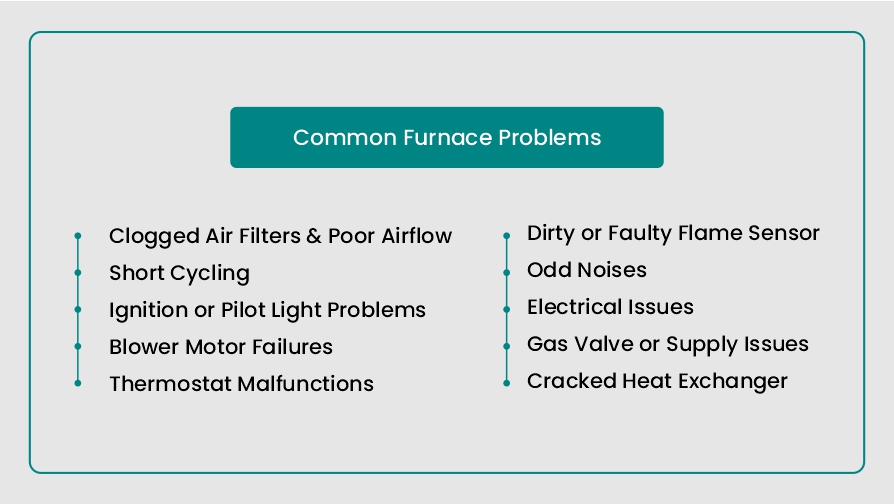
Dirty filters or blocked ducts restrict airflow into the furnace, causing it to work harder. Clogged filters not only raise energy use, they can trigger safety shut-downs to prevent overheating. The fix is simple: check and replace filters every 1–3 months, and clear any vent obstructions.
If the furnace turns on and off too quickly, it never reaches the set temperature and wastes energy. Short cycling can be caused by clogged filters, incorrect thermostat settings, or an oversized furnace heating the space too fast. Over time this wear-and-tear can damage components, so a technician should diagnose the underlying issue.
Gas furnaces rely on a pilot light or electronic ignition. If these fail (due to dirt, wear, or clogged gas lines), the furnace won’t start or will shut off prematurely. A red or flickering flame, or no flame at all, often indicates ignition trouble. While some simple cleaning can help, a technician may need to replace the ignitor or pilot assembly.
The blower fan circulates warm air through the ducts. When the blower motor fails or is obstructed, airflow drops sharply and rooms stay cold despite the furnace running. Signs include little to no airflow at vents or a blower that won’t turn on. If the motor is seized or wearing out, professional repair or replacement is needed before the system overheats.
Sometimes the problem is not the furnace but its controller. Faulty thermostat wiring, dead batteries, or misconfigurations can make the furnace run erratically or not at all. Always check that the thermostat is set to “Heat” and has fresh batteries before assuming a furnace failure. If calibration or wiring issues persist, replacing the thermostat may be necessary.
The flame sensor tells the furnace when the burner’s flame is lit. If the sensor is coated with soot or fails, the furnace will shut down as a safety precaution, thinking the flame is out. This causes the furnace to spark for ignition but shut off before heating. Cleaning or replacing the flame sensor (usually a simple fix) often restores normal operation.
Furnaces should run quietly. Rattling, banging, squealing, or grinding sounds often indicate loose parts, worn belts, or motor bearings failing. These sounds should be checked promptly by an HVAC professional – ignoring them can lead to more serious damage.
A tripped circuit breaker or blown fuse interrupts power to the furnace, preventing it from turning on. Check the electrical panel first if your furnace is completely unresponsive. If breakers keep tripping, it may signal an overloaded circuit or an internal fault, both requiring a technician’s attention.
If the gas valve doesn’t open or the supply is interrupted, the furnace will not get fuel and won’t heat. Symptoms include the furnace trying to start but failing to ignite. Since gas-handling components are safety-critical, any issue with gas flow should be inspected immediately by a qualified technician.
This is one of the most serious problems. A crack in the heat exchanger (the part that heats air) allows deadly carbon monoxide to leak into the home. Warning signs include a yellow or flickering flame, soot or rust, and foul odors (including a pungent or “metallic” smell). If a cracked exchanger is suspected, shut off the furnace and have it evaluated right away by a professional, as it often means replacement of the heat exchanger or the entire furnace.
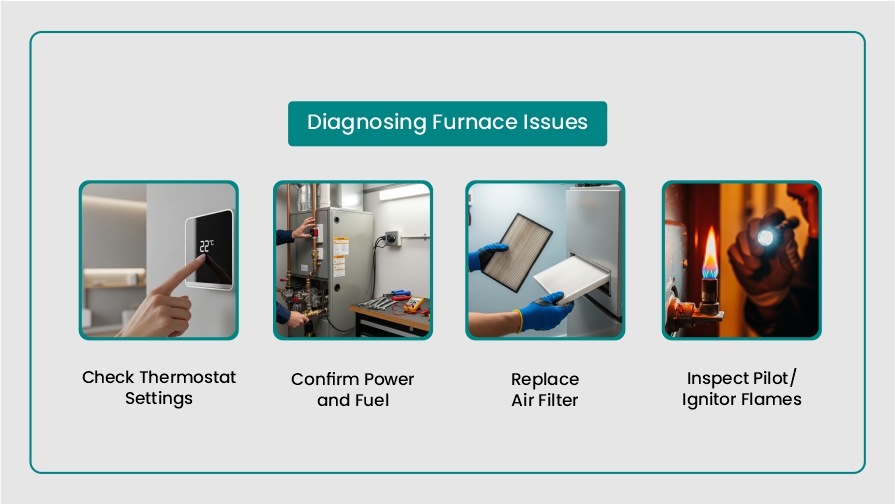
Before calling for service, you can perform some basic checks:
These simple steps cover many minor issues. However, issues involving electrical components, gas lines, or the heat exchanger require a professional’s expertise. Licensed HVAC technicians have the tools to safely diagnose and fix complex faults. As Triple-O HVAC experts warn, failure to have an annual inspection can allow hidden issues (like cracks or leaks) to worsen.
Repair costs vary widely based on the problem. Industry data show that typical furnace fixes run in the low hundreds of dollars. A survey of homeowners finds average repair costs around $317, with a normal range of roughly $132 to $502 for individual repairs. Similarly, HVAC cost reports indicate that common furnace repairs typically fall between $300 and $600. Of course, extensive repairs can exceed $1,000 if major components need replacement.
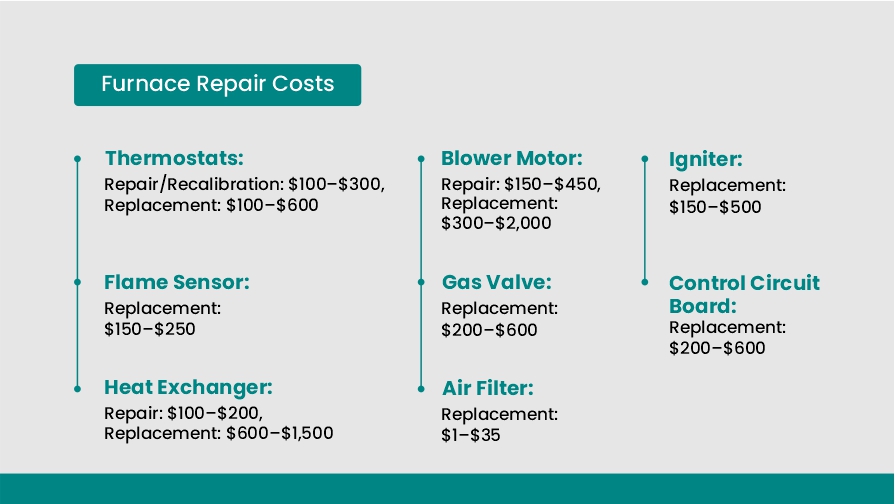
Below are ballpark figures for common furnace repairs in the U.S.:
Technicians typically charge $50–$150 per hour for furnace work. Emergency or after-hours service can greatly increase the rate (to $150–$600/hr). A simple parts swap might take an hour or two, whereas complex repairs (like accessing a heat exchanger) can involve several hours of labor.
The type of furnace and fuel make a difference. Electric furnaces tend to have fewer components to fail, so repairs often run lower (typically $100–$400) compared to gas furnaces ($100–$550 or more). Regional labor rates also vary: major cities and cold-climate areas often have higher hourly rates. Part accessibility matters too – a hard-to-reach blower or inducer motor can increase labor time. Finally, the age and condition of the furnace play a role: older systems (over 15 years) may need more extensive work, so quotes can be higher.
In practice, repair shops use a combination of flat-rate pricing for common jobs and time-and-materials for unusual issues. Getting multiple estimates is wise, as one technician may charge more per hour than another. Expect routine repairs under $500, but budget up to $1,000+ if major components (like the heat exchanger or compressor) need replacement. In all cases, balancing repair cost against furnace age (see below) will guide your decision.
The most effective way to minimize repair bills is regular maintenance. Annual tune-ups by an HVAC professional can catch small issues before they become emergencies. During a pre-season check-up, a technician will clean burners and coils, lubricate moving parts, check gas pressure and thermostat accuracy, and ensure all safety controls function. American Standard reports that a tune-up “improves energy efficiency and helps catch potential issues before they become major problems,” also extending the furnace’s lifespan.
Homeowners can handle some tasks themselves between visits: the most important is filter replacement. EnergyStar advises inspecting or changing filters monthly (especially during heavy use). A clean filter prevents strain on the blower motor and keeps airflow strong. Skipping this simple step “can increase energy costs and damage your equipment, leading to early failure”. Other DIY tips include keeping the area around the furnace clear, checking that vents are open, and ensuring the thermostat area is free of drafts or obstructions.
For safety, also install a carbon monoxide (CO) detector near any gas furnace. A sudden spike in CO (rotten-egg smell) is a serious warning sign – if you ever detect it, leave the home immediately and call the gas utility. Regular maintenance will catch issues like cracked heat exchangers, which otherwise could go unnoticed. In short, consistent care (both DIY and professional) is the best way to avoid unexpected breakdowns and high repair costs.
Even with repairs, furnaces have a finite life. Most gas furnaces last about 15–20 years under normal use. An electric furnace may last longer, but even it will eventually wear out. If your furnace is in the mid-teens age range and showing multiple problems, it’s wise to consider replacement. American Standard warns that a furnace over 15 years old is at or approaching the end of its life expectancy.
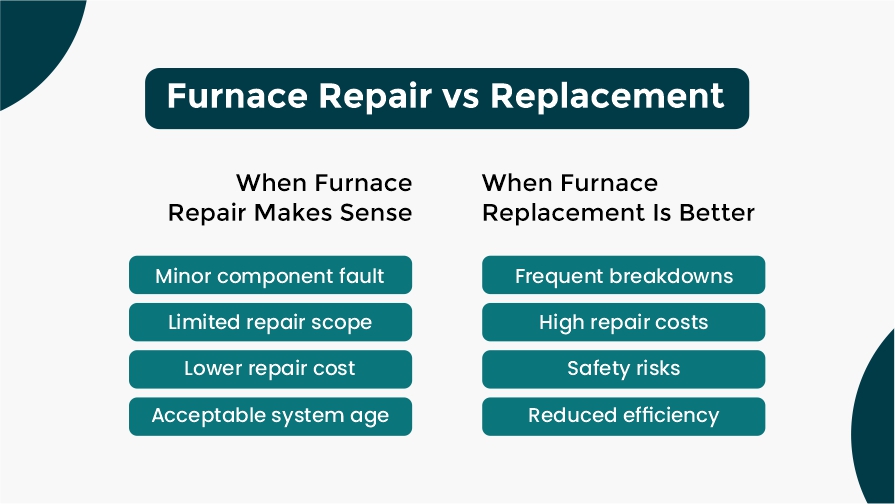
Over time, aging furnaces become less efficient and need more frequent repairs. Experts note that if you’re scheduling major repairs (or multiple small repairs) every year, it might make more financial sense to invest in a new unit. As a rule of thumb, if a repair estimate exceeds about half the cost of a new furnace – especially for an older system – replacement should be considered. For example, replacing a cracked heat exchanger alone can easily cost over $1,500, whereas a new furnace with high efficiency may provide years of trouble-free heat (and lower utility bills).
In colder climates where the furnace runs constantly, efficiency gains from a modern unit (90%+ AFUE rating) can pay off. Moreover, new furnaces often come with warranties and can qualify for energy tax credits, offsetting the higher upfront price. Ultimately, consult with an HVAC professional about your options: they can compare your system’s age, current repair needs, and expected running costs. If you have plans to sell or renovate the home, a new furnace can even add market value and buyer confidence.
Furnace problems span a spectrum from minor (dirty filters, thermostat errors) to severe (gas leaks, cracked heat exchangers). By learning the warning signs and performing regular maintenance, homeowners can often prevent unexpected failures and control costs. When repairs are needed, most fall in the $100–$600 range, but prices can climb for major components or emergency service. Always compare repair estimates against the age and efficiency of your furnace – if your system is old or the fix is very expensive, replacement may be the safer long-term choice. Above all, work with qualified HVAC technicians to ensure safe, reliable repairs and replacements. With proactive care and professional advice, you can keep your home warm, energy costs down, and your family safe all winter long.
Join our mailing list for exclusive updates, expert tips, and special offers tailored to your needs. Be the first to know about the latest in home services.

Renovize Home is a platform that supports homeowners from planning to renovation. Whether it’s Renovize AI for guidance or a one-on-one call with Pro Finder, we understand your project and match you with local contractors tailored to your needs.
Who We Are
About Renovize HomeGet in TouchHomeownwer Support:
Coming Soon!
General Inquiries:
support@renovizehome.com
Head Office:
24 Greenway Plaza, STE 1800M, Houston, TX 77046.